











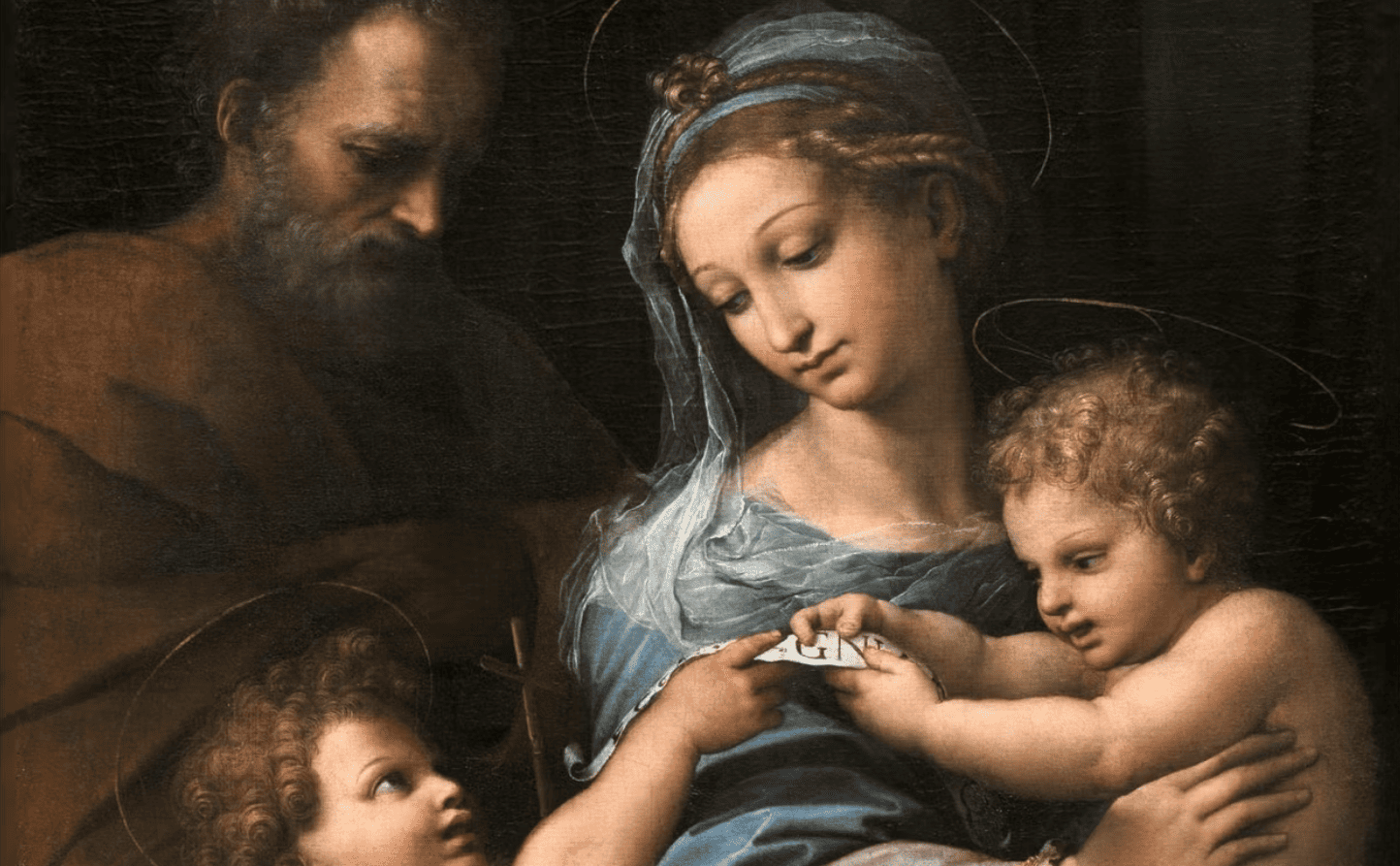
The image Madonna della Rosa or Madonna of the Rose, courtesy of Museo Nacional del Prado/PA
Artificial intelligence (AI) can identify details in paintings that are often invisible to the human eye. Using an innovative AI method, UK scientists have discovered an unusual detail in the 16th-century painting “Madonna della Rosa” by one of the most famous Italian artists and architects of all time, Raphael. It turns out that one part of the painting was probably not painted by Raphael himself.

Mystery „Madonna della Rosa“
The origin of Raphael’s famous painting “Madonna della Rosa” remains a mystery. Although the work has always been attributed to Raphael, experts have noted that the St. Joseph depicted in the painting differs from the other figures in terms of color palette and brushstrokes. This suggests that his image may have been painted by other masters in Raphael’s workshop.
“The attribution to Raphael’s workshop was gradually accepted later, especially when the work began to be associated with his painter students – Giulio Romano, and, possibly, Gianfrancesco Penni,” Professor Howell Edwards of the University of Bradford in the United Kingdom emphasized in a landmark study.
He also assured that during the entire time this painting was stored in Spain, no one doubted its authenticity.
Although determining the provenance of a work of art requires a wealth of evidence, a new analysis method based on AI has confirmed the hypothesis that at least some of the brushstrokes could have been made by another artist.
AI sees down to the microscopic level
The researchers developed a special algorithm based on Raphael’s confirmed works.
“Using deep feature analysis, we trained the AI to recognize Raphael’s style in extreme detail – from the strokes and color palette to the shading and every element of the work. The computer sees much deeper than the human eye – down to the microscopic level,” explained Hassan Ugail, a mathematician and computer scientist at the University of Bradford.
Machine learning algorithms typically require a large number of samples, but a single artist’s work often has too few. So the researchers used Microsoft’s pre-trained “ResNet50” algorithm and combined it with traditional (Support Vector Machine) techniques. This allowed the system to accurately recognize Raphael’s style even with a limited number of samples.
This method has previously been shown to be 98 percent accurate in identifying Raphael paintings. Normally, the algorithm analyzes the entire painting, but this time the team asked it to carefully evaluate individual faces as well.
Although the Madonna, the baby Jesus, and St. John were confirmed as works by Raphael, the face of St. Joseph turned out to be completely different. In previous discussions, it had already been considered less masterful than the painting of the other figure.
“When we tested the “Madonna della Rosa” painting as a whole, the results were inconclusive. Then we analyzed the individual parts – and while the rest of the painting was confirmed as Raphael’s work, the face of St. Joseph most likely belongs to another artist. This is another example of how modern technology is revealing the secrets of classical paintings – this time with the help of AI,” said H. Ugail.
AI helps art experts
It is believed that the Madonna della Rosa was painted on canvas between 1518 and 1520. As early as the mid-19th century, art critics began to suspect that the entire painting might not have been Raphael’s work.
Now, these suspicions have almost certainly been confirmed. The research team also emphasizes that AI will assist art experts in the future, not replace them.
“This is not a case of AI taking away people’s jobs. Determining the authenticity of a work of art involves many aspects – from origin and pigments to the condition of the work. Such software can be used as one of the tools that help in this process,” assured H. Ugail.
Credits:
Image: