










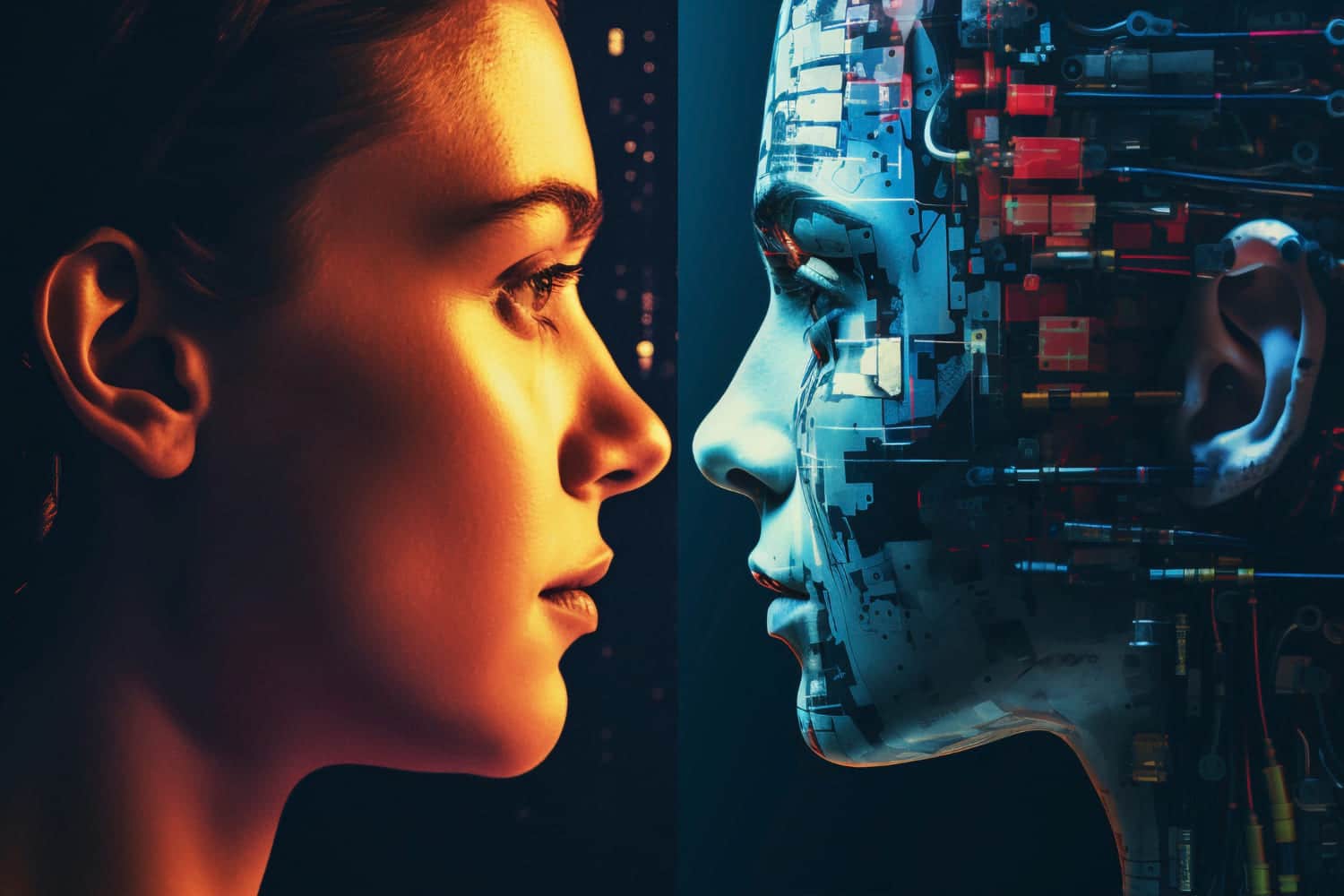
Let’s say you wake up, have a cup of morning tea, and open your digital tasks book like Figma, only to find that your next design session has already been completed. Personas? Generated. Wireframes? Done. Text? Written in your brand tone. User testing? You’ve already repeated the process.
And all thanks to your new fellow employee, Artificial Intelligence.
ChatGPT can create microcopy, Midjourney can create visual elements, and Uizard can quickly generate schematic layouts… What will happen to you?
You may also like:
Anyone who has worked with UI/UX in the last six years has seen some progress as everything went from sketches on paper to design tools that can nearly think for themselves. And I’m not writing this to scare you, but because there are a lot of question marks and I want to warn you.
This can become a reality.
By the end of this article, whether you’re a designer, a company founder, or simply interested in AI, you’ll have:
- What AI can do (the bright side)
- What he can’t (and probably never will)
And how to secure your future without becoming a prompt engineer right away.
Where (AI) is still failing
Like every machine, it has its drawbacks, such as:
- Emotional deficiencies: AI cannot feel disappointment due to a poor design process.
- Creativity blind spots: It reshuffles current patterns but doesn’t create new ones, like dark mode or Tinder swipes.
- “Why?” Doesn’t count: AI can’t answer questions like “Why do consumers abandon carts?”, but it can detect trends.
According to a 2024 study by Adobe, 61% of designers use AI for at least one task. However, only 8% trust it for an entire project.
What (AI) does well
It can be praised for the following capabilities:
- Speed: Imagine being able to create 100 wireframes in less than 10 minutes. It’s real.
- Data analysis: Finding user drop-off areas on huge heatmaps? AI eats this up like breakfast.
- Pattern recognition: AI can find patterns in large data sets that humans might ignore.
What it isn’t good about:
- Empathy: AI does not notice differences in cultural or emotional weight.
- Contextual design thinking: Unclear signals lead to inaccurate results.
- Originality: It weaves the past into it. True creativity? It’s still a human game.
UX design jobs at risk
According to McKinsey’s creative jobs report, 30–45% of repetitive creative work might be automated by 2026.
The study concludes that AI will not eliminate UX or UI jobs but will redefine them: future UI designers may function more as interface usability advisors, while UX designers take on roles as product experience architects or “usability solution providers,” working alongside AI.
The World Economic Forum predicts that while AI will continue to impact existing jobs, it will create 92 million new digital jobs by 2030. Additionally, according to the World Economic Forum’s 2023 future of jobs report, it is predicted that companies will prioritize design and UX skills as the most important technology skills (in addition to AI and big data) between 2023 and 2027.
AI tools (e.g., generative design software like Uizard, Adobe Sensei, ChatGPT) are now used in UX/UI design to quickly generate wireframes, layouts, prototypes, and other design assets, significantly speeding up the interface design process.
UX designers also become experience strategists and “AI collaborators,” driving the overall design vision and ensuring that interfaces created by AI actually meet user needs (something AI alone cannot guarantee).
Accept it, or..?
It’s impossible to ignore this, it’s not going away anytime soon, and it’s important to understand it. I won’t go into details.
Why is AI progressing so fast? Has it been here before?
No… let’s leave that for another day. We’re here today because many of you designers may fear of AI or questioning your own decisions to choose this career path.
I’ve heard all the questions related to AI… for example:
Should I start learning a new skill when AI is around?
It’s not worth it… It will take me years and the AI can do it in a week or so.
Let me just sit in a corner and watch it overtake me.
If you ask me, AI shouldn’t be designing, animating, coding, or 3D for us. It should be removing the boring tasks from our lives and allowing us to enjoy the creative freedom we all love and explore.
Unfortunately, these days people are sluggish and using it wrong way. Which may result in many people being discouraged or even disgusted by stealing their jobs.
How (AI) transforming the UX industry
The impact of AI on the UX industry is enormous, bringing with it a multitude of opportunities and challenges. Here’s what the advent of AI means for UX professionals right now:
- The traditional UX toolkit is undergoing a major overhaul as new AI-powered tools and features are rapidly released. UX designers must learn to embrace these new tools, understand their limitations, and remain adaptable as tools and technologies continually evolve.
- Thanks to AI, UX designers can now automate routine tasks, streamline their workflows, and leverage vast amounts of data and analytics. This means that the nature of work is slowly but surely changing. This requires adaptation.
- Directly related to the two previous points about new tools and technologies and the changing nature of the profession, UX designers will need to acquire and utilize different skills. Research skills are now more important than ever, as are strategic thinking, problem solving, empathy, and intuition.
- AI is taking things to the next level, empowering designers to create highly personalized products and experiences. The bar has never been higher. UX designers will need to find ways to make their products stand out, and emotional design will play an increasingly important role.
- AI poses many challenges related to user trust, transparency, bias, manipulative design practices, and unintended consequences. As AI becomes increasingly integrated into the UX process, designers will need to be careful to ensure that their design practices are ethical, inclusive, and safe for the user.
The bottom line
It can be daunting to read about the rapid rise of AI and the impact it will have in the near future. However, I hope this post helps to dispel some of your fears about how artificial AI might impact the role of the UX designer. At this point, it is highly unlikely that artificial intelligence will replace the need for UX designers.
Ultimately, UX is too dependent on the “human touch”; empathy will always be key when it comes to creating user-friendly products. Artificial intelligence will play an increasingly important role in the UX design process, but we see it as an opportunity, not a threat.
Credits:


