











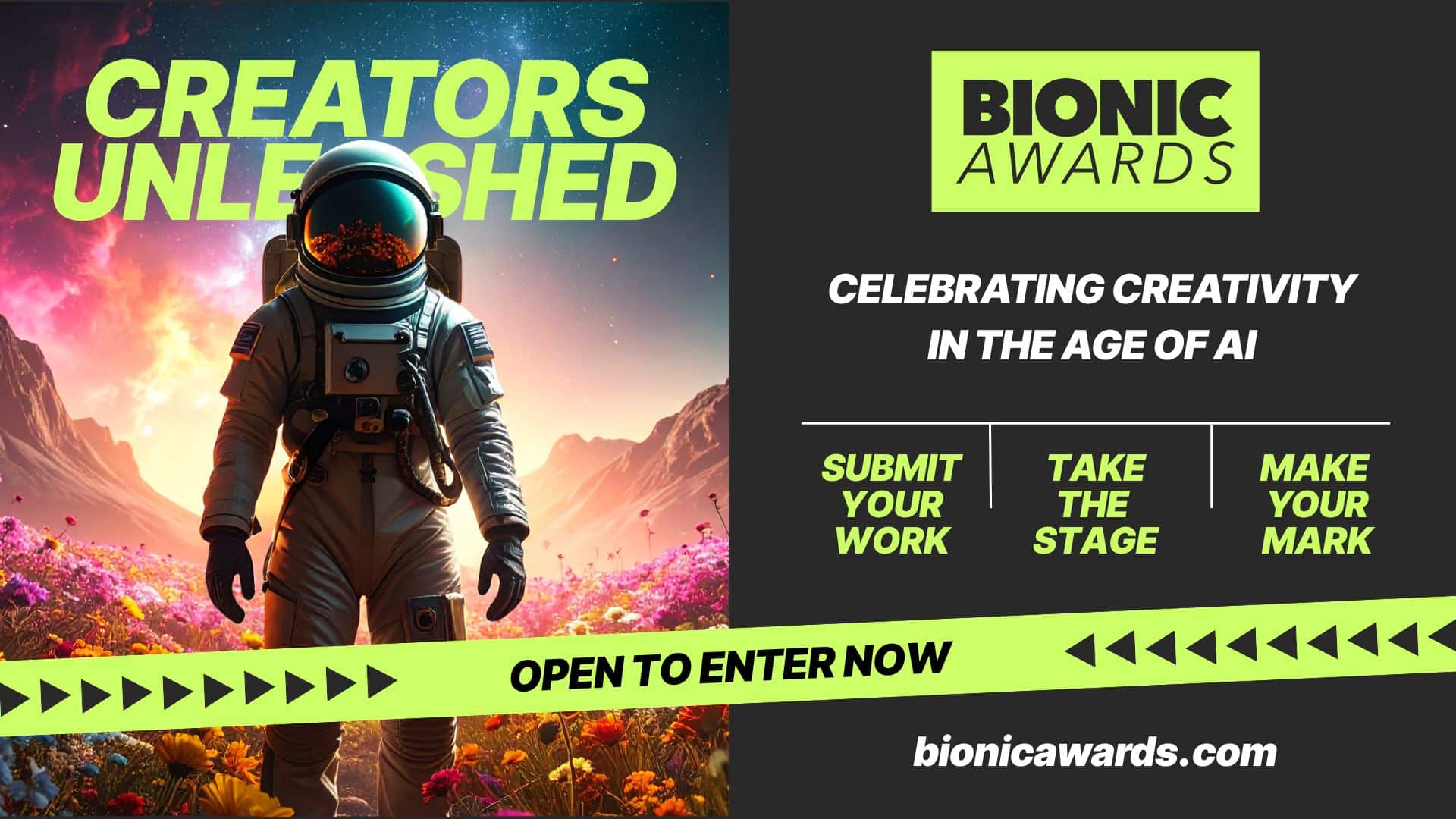
The Bionic Awards spotlight the next wave of creative AI talent in film, advertising and creator-owned content. From branded films and experimental pilot films to viral moments and outdoor digital installations.
With a far broader scope than most AI festivals, Bionic is open to everyone. That includes filmmakers, freelance creatives and agencies. Let’s be honest, AI competitions are everywhere these days. But who organizes them? It’s usually the AI companies themselves. Which makes them, rightly or wrongly, more like marketing exercises than a true celebration of the craft.
But the Bionic Awards look different.
How it all started
Founded by Alex Pell, technology editor at “The London Standard”, and Andy Gordon, an award-winning film producer who has created campaigns for Google and Coca-Cola, Bionic emerged from a specific moment.
While chairing London Tech Week 2024, Alex saw the panic and excitement among creatives when “doom” was the opposite trend, and realized that the community needed support, not promotional offers.
I met Alex and Andy last week at Upscale – an AI conference in Málaga, Spain, organised by Freepik, and got swept up with their passion and enthusiasm for the project. So while I’ve always been super-cautious of people touting the “next big thing” (whether that’s the metaverse, blockchain or, now, AI), this grass-roots project caught my attention.
What makes it stands out
While this is a passion project, it’s backed by serious ambition: to create world-class events and build a global community that genuinely helps creatives. “Our vision is for The Bionic Awards to be the European equivalent of The Webbys and spotlight exceptional creators in the AI era,” Alex explains.
More specifically, it aims to help people who are worried about losing their jobs, but are also curious about new opportunities. As a result, start-up costs are deliberately kept low, and the overall approach is focused on specialists, not on making a profit.
“I won a Webby Award ten years ago,” reflects Alex. “They said we could attend to collect our prize, but only say five words on stage, and also that a second trophy, for my partner, would cost us £400. Bionic is much more inclusive, and our ethos is ‘creators first’. The goal is to give creatives the visibility and connections to succeed as the industry evolves.”
He points out that the judging panel includes people who actually make things with AI. Brandon Baum is Europe’s leading AI developer with 25 million followers. Jens Christensen, post-production director at “Pinewood Studios”. Ryan Phillips (aka Uncanny Harry), considered the UK’s leading AI filmmaker, recently signed a deal with Hollywood studio “Promise”.
Then there’s Alvaro Corrochano, head of virtual production at “Hogarth | WPP”; Pedro Oliver, senior creative for “The Coca-Cola Company” at “Studio X” and; and Jo Wallace, global executive creative director at “Jellyfish”. All people working at the sharp end of creative evolution.
The story of another judge, influencer Afro Futcha aka Diane Laidlaw, encapsulates what Bionic represents. “I was a web designer for 15 years and did not have the opportunity to retrain in film,” she explains. “But AI has unlocked the door for me to become a filmmaker.” That’s lived experience, not corporate rhetoric.
Global event in London
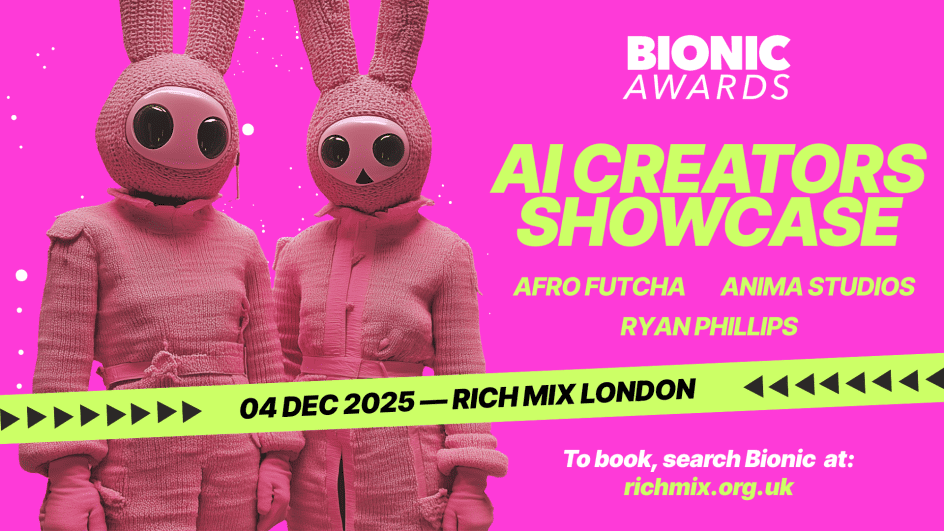
Bionic launches with London roots but global ambitions. The inaugural AI Creator Showcase takes place at Rich Mix in Shoreditch on 4 December, entries close on 30 December, and the main awards are held on 5 March 2026.
The timeline reflects how fast creative AI is moving. As Alex frames it: “The tide has turned on conventional creativity. You can ignore reality and wait for the waves to find you, or learn to swim.”
If you’re skeptical about AI, Bionic won’t try to convince you. But if you’re interested, you’ll find a community that’s quietly exploring similar issues. Entries must demonstrate “meaningful uses of generative video” while remaining platform-neutral. In other words, whether you use “Runway”, “Pika”, or “Google Veo” matters less than what you create.
With 12 categories spanning storytelling in ads, art installations, digital-out-of-home (DOOH), and more, Bionic supports many types of creative work.
It’s worth noting that the awards don’t just embrace purely GenAI films but also hybrid workflows, such as using AI for VFX or to enhance onscreen human presence. The focus stays on output, not tools.
Worth your attention
If you want to see what creatives are actually doing with AI, not what AI companies say they should be doing, this is worth your attention.
Find out more at bionicawards.com, or get tickets for the 4 December AI Creator Showcase at Rich Mix.
Credits: