












Cosmic collision: what will happen if asteroid YR4 hits the Moon in 2032
The impact would cause an infrared glow and a possible meteor shower on Earth.

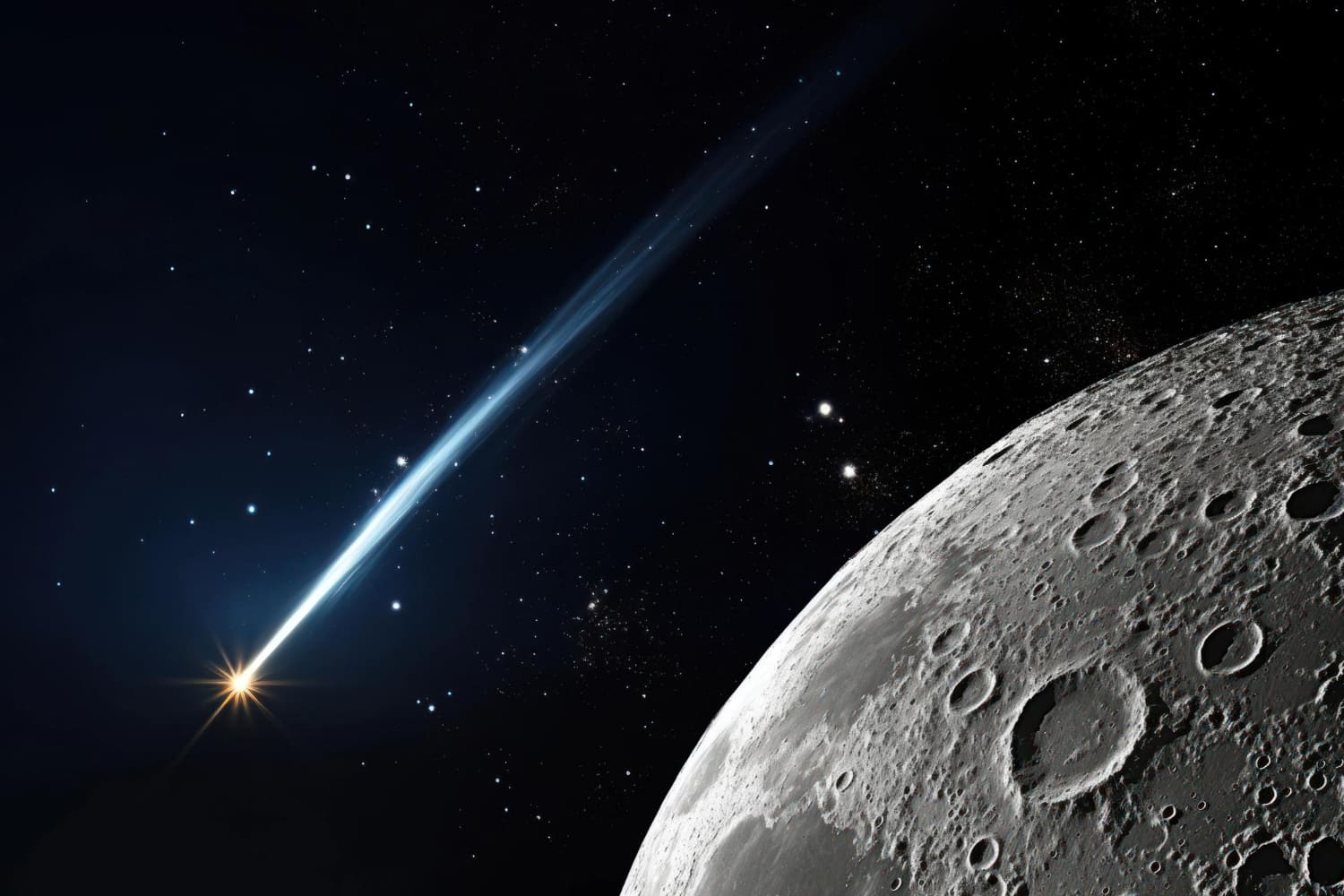
Scientists are exploring a scenario of what would happen if asteroid 2024 YR4 were to hit the Moon in 2032. A new study suggests that such an impact could cause a bright flash on the Moon’s surface visible from Earth, throw some debris into our planet’s atmosphere, and even create a brief meteor shower.
The researchers also predict an infrared glow that could remain visible for hours after the impact, providing a unique opportunity to observe the event in real time.

Probability and threat assessment
Asteroid 2024 YR4 became one of the most talked-about topics in the first half of 2025, when it was reported that there was a possibility that this large cosmic body could hit Earth in 2032. It was discovered in December 2024 and initially caused concern, as scientists estimated that the probability of its collision with Earth was 3.1 percent. At that time, the asteroid was far from our planet, but it is expected to return in 2032.
Astronomers worked to determine the asteroid’s orbital trajectory in as much detail as possible before it disappeared from view in order to accurately calculate the threat to Earth. Subsequent observations and data from the James Webb Space Telescope have almost completely ruled out a collision with Earth, but have raised the possibility that it could hit the Moon.
By April 2025, revised measurements determined that the asteroid’s diameter is about 60 meters, and the probability of hitting the Moon is 3.8 percent. Although the asteroid will remain undetected for several years, scientists are already preparing for its return on December 22, 2032.
The impact of this phenomenon on us
The authors of the NASA article created a timeline showing what would happen from the moment of impact to the days, weeks, months, and years after it.
- Moment of the impact
The study suggests that an impact by asteroid 2024 YR4 on the Moon would produce a flash of magnitude -3 to -5. If it were to hit the dark side of the Moon, the flash would be visible to the naked eye.
With professional telescopes, astronomers could observe the flash in real time, and perhaps even detect chemicals ejected from the surface.
Even if the impact occurred on the illuminated side, just beyond the “terminator” – the line separating light and shadow – the flash could still illuminate the surrounding terrain.
- Minutes – hours after the impact
Just minutes after the flash, a crater about 1 km in diameter on the Moon would glow in infrared for several hours, allowing infrared telescopes to observe its cooling glow. Large lunar earthquakes could reach seismometers within 7 to 15 minutes.
The study authors note that the impact could be studied in a variety of ways: infrared observations, seismological measurements, and observation of the crater by orbital stations.
- Days – years after the impact
After 2-8 days, the debris reaching Earth could cause a visible meteor shower. A small fraction of the fragments may survive the fall through the atmosphere, fall to Earth, and be discovered as lunar meteorites in the coming years.
Credits:
Image:


