













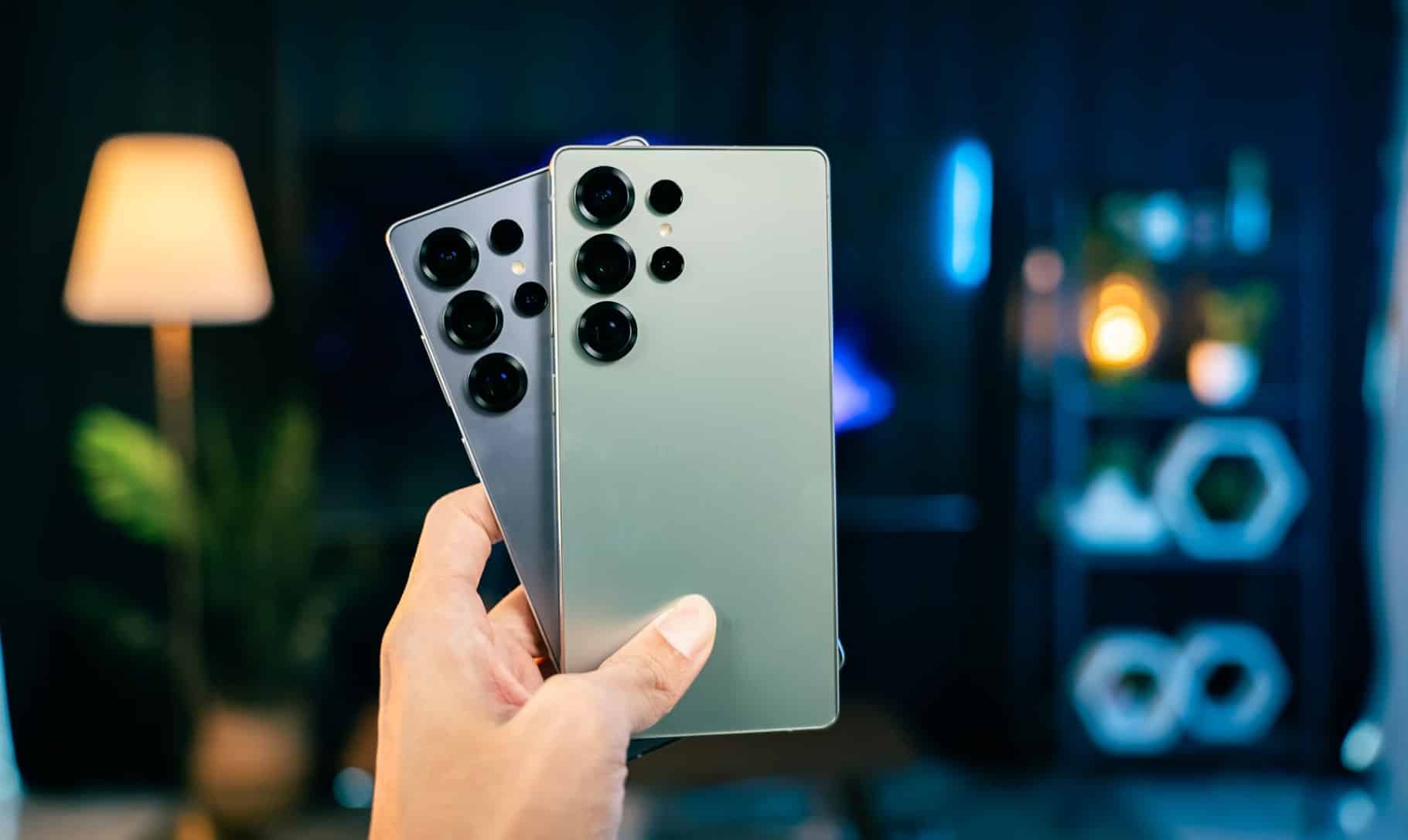
Smartphone manufacturing has long been associated with thousands of meticulous hands assembling the tiniest parts. But tech giant Samsung is increasingly demonstrating that the role of humans in the factories of the future could become increasingly limited. In South Korea, the company has begun a process that seemed like science fiction just a few years ago – robots are gradually taking over tasks previously performed by humans.

Business news outlet The Bell reports that an autonomous robotic arm is now operating at a Samsung factory in Busan, taking over a key part of the Galaxy phone manufacturing process. It’s a small but symbolically significant step toward a fully automated production line.
A simple task that requires immense precision
The new robot is currently performing what appears to be a simple task – attaching authentication stickers to the back of manufactured devices. It sounds like a small detail, but in reality, this procedure requires extreme precision.
The backs of modern phones are often made of glass or extremely thin plastic, so even the slightest improper pressure can scratch or damage them. The human hand does this intuitively, while a robot requires millimeter precision and extremely sensitive force control. That is why this task was chosen as one of the first serious attempts to entrust robots with work that has so far been performed only by humans.
Samsung’s partner, “Wonik Electronics”, has already introduced the first models of robots adapted for this function. Although they are currently being used in only one factory, industry experts are confident that this is just the beginning.
A robot that resembles a human hand
Interestingly, the current robot is just an interim step. The Bell reports that the manufacturer is already developing an even more advanced robotic arm with as many as 21 degrees of freedom. In simple terms, this means that the next-generation robot will be able to move almost as flexibly and precisely as a human hand.
Such a technological leap would allow robots to perform not only sticker application, but also much more complex operations: assembling small parts, connecting components, or even quality inspection. The closer a robot is to human capabilities, the more manufacturing processes can be fully automated.
It is not yet revealed whether this technology will be implemented in other Samsung factories around the world, but it is obvious that the direction chosen is very clear.
South Korea is the world champion in robotics
Samsung’s move is not an isolated incident. South Korea is already considered the world leader in the number of industrial robots. According to the International Federation of Robotics (IFR), the country has one industrial robot for every ten workers, the highest rate in the world.
Automation on this scale is changing not only the way factories operate, but also the entire labor market. Robots work faster, more accurately, and without interruption, making them an increasingly attractive alternative to human labor for companies.
A similar trend is visible in Europe. IFR reports show that Germany is the absolute leader in industrial robots on the Old Continent. In 2024, the country had about 280 thousand robots in operation – which was as much as 40 percent of the entire robot fleet in the European Union. However, even these numbers do not match the pace of South Korea.
What does this mean for the ordinary consumer?
At first glance, it may seem that robots in factories are just an internal industry issue. However, in reality, it directly affects ordinary smartphone users as well.
Greater automation means more consistent product quality, fewer human errors, and faster production processes. This can lead to lower production costs, faster time to market for new models, and even longer equipment reliability.
On the other hand, social questions are also being raised more and more loudly: what will happen to workers whose jobs will be taken over by robots? How will the labor market change in the technology sector? These are discussions that will become increasingly relevant in the future.
The first step towards a fully automated future
Samsung’s decision to entrust even a small task to a robot is much more than just a technical innovation. It’s a sign that smartphone manufacturing is entering a whole new era, one in which artificial intelligence, automation, and robotics will play an increasingly important role.
Today, a robot applies stickers. Tomorrow, it can assemble entire phones. And in a few years, we may see factories where human hands are needed only for maintenance and control.
The technological revolution is already underway – silently, precisely, and without interruption. Just like the robots that are creating it.
Credits:
Image: